
Sand Overview

Udonosu Beach has coarse sand consisting of eroded remnants of fossilized coral skeletons, coralline algae and marine shells.


Different species of light tan foraminifera and chalky white fragments of coralline algae surround a round white foraminifera grain with internal radially arranged segments.
Geographic Overview


Udonosu Beach is on Yoron Island, 20-square kilometer island located in Kagoshima Prefecture just north of Okinawa. The beach has white sand, crystal-clear and calm turquoise waters, a nearby coral reef, and boasts of frequent sea turtle sightings.
The island is an elevated coralline island with a highest point 97 metres (318 ft) above sea level. The coarse white “coral sand” consists of the eroded remnants of fossilized coral skeletons, coralline algae, and marine shells. The coast of the island is surrounded by a coral reef.

Sand Location
See where this sand sample was collected on Google Maps.
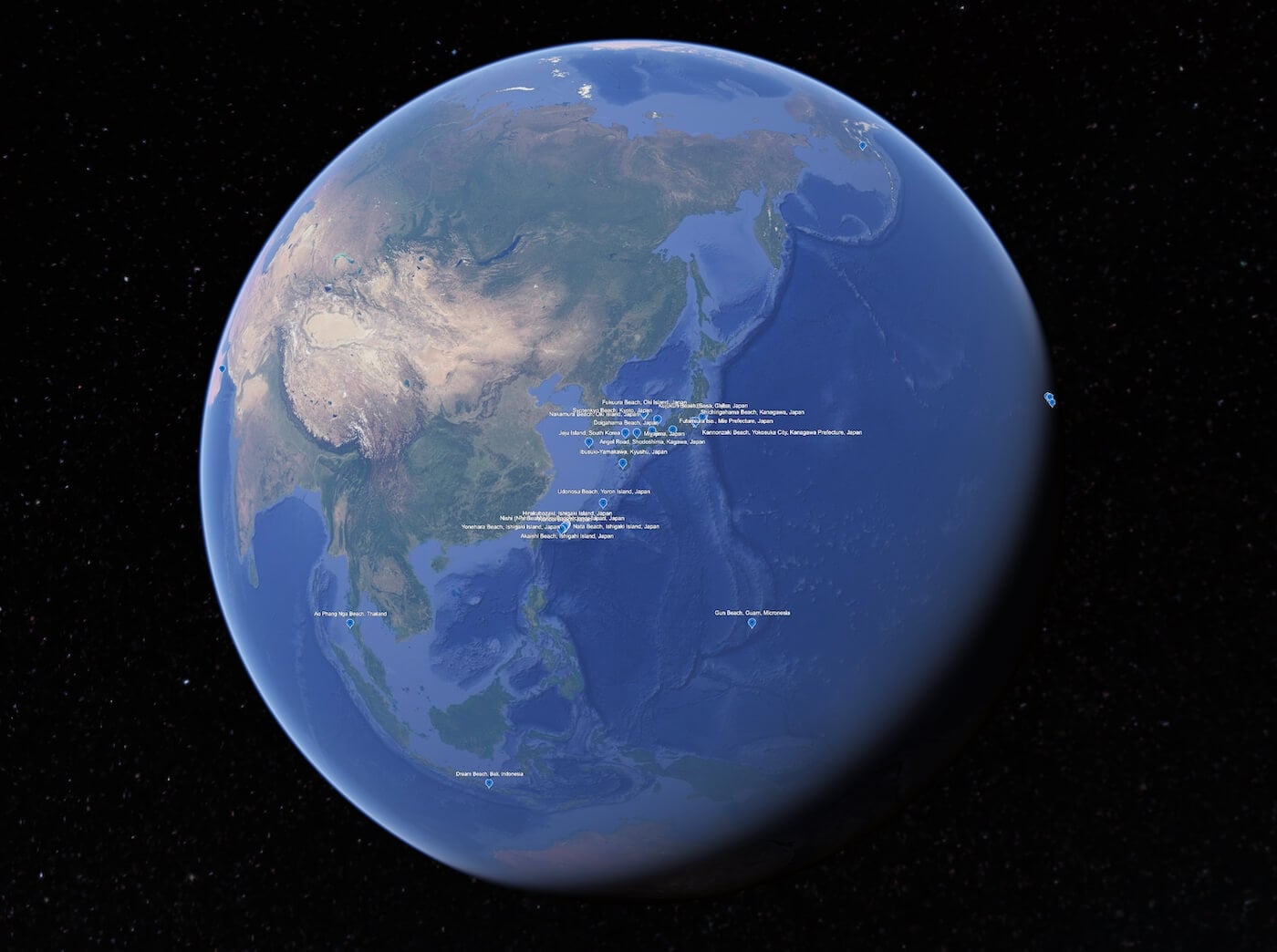
Virtual Sand Tour
Explore an interactive map of Udonosu Beach on Google Earth.
Sand Gallery

In addition to at least four foraminifera species, including Baculogyjpsina sp., two sea urchin spines with parallel linear striations are present along with irregularly shaped white and semi-translucent fragments of coralline algae.

This high magnification view includes mixed fragments of marine sand grains including smoothly worn white and tan foraminifera species and a couple of fragments of sea urchin spines with parallel linear grooves. The pink sand grain may be a chunk of a bottom-dwelling Homotrema sp. foram and the brown and white sand grain is possibly a mollusk shell fragment.
Different species of light tan foraminifera along with irregularly shaped chalky white fragments of coralline algae surround a round white foraminifera grain showing internal radially arranged segments (possibly an Amphistegina sp.). The irregularly shaped white chard with brown spots may be a fragment of a marine gastropod. A white fragment with linear arranged openings at the lower left of the high magnification is possibly a piece of a Marginospora sp.

Multiple smoothly worn and rounded and speckled light tan foraminifera species and irregularly shaped white and off-white fragments of coralline algae represent the variety of sand grains in this low magnification view. A small conical mollusk shell near the lower right of this view has linear brown markings. An irregularly shaped brown and white sand grain at the upper might may be a mollusk shell fragment.

These sand grains include multiple smoothly worn tan foraminifera species, some showing internal compartments, along irregularly shaped white and semi-translucent fragments of coral. A couple of coral fragments have irregular holes representing evidence of bioerosion.